The short answer
In Fort Lauderdale, a house, duplex to fourplex, or condo unit rented to guests more than three times a year for under 30 days needs a City certificate of compliance, issued only after a paid inspection. Ordinance C-26-39, approved September 15, 2026, set a $1,000 daily penalty for renting without one or on an expired one.
This guide is the paperwork and the walk-through. The rentals at Luxury Rentals, listed in the MIAMI REALTORS® MLS, carry a short summary of the certificate.
What did Ordinance C-26-39 change?
The program dates to Ordinance C-15-29, adopted August 18, 2015. C-26-39 passed first reading on August 18, 2026 and was approved on September 15, 2026. Its own text says it takes effect 30 days after adoption, which by our count is October 15, 2026.
Four changes matter to an owner. First, any operation without a valid certificate now draws a civil penalty of $1,000 for every day it continues, and each day is a separate violation. Second, renting on a certificate that has lapsed counts the same way; the City's notice says that daily figure was $250 before. Third, a renewal submitted complete and before the deadline is shielded from the penalty if the only holdup is the City's own processing. Fourth, a new owner, a new company or a new manager does not wipe out open violations, fines or suspensions where the City finds a continuity of ownership or control, which the ordinance defines as a prior shareholder, officer or member staying on, holding an interest, or still running the place.
The City's notice adds that a certificate cannot be issued or renewed while the property has an active code violation. And after a complaint about unpermitted work, a fire hazard or another safety condition, the owner must give the City reasonable access; refusing is itself a violation.
In what order do the state, county and City filings go?
The City wants the outside licenses first. The state license comes from the Department of Business and Professional Regulation (DBPR). DBPR requires one when a whole unit is rented out over three times a calendar year for stays under 30 consecutive days. It issues a condominium class for a unit in a condo or co-op and a dwelling class for a house, townhouse or a unit in a duplex to fourplex.
Taxes come next. Florida levies a 6 percent tax on transient rentals, and Broward County adds its own 6 percent tourist development tax on stays of six months or less. County returns are due on the first of the month after collection and are delinquent if not postmarked by the 20th. If a booking platform collects and remits either tax, the City accepts a notarized letter saying so in place of that registration. A Broward County business tax receipt is also on the list.
Then the City. The application goes through LauderBuild with proof of ownership, a blank or sample guest lease, and a sketch or photo of the off-street parking marked with the words that on-street parking is not permitted. An owner's representative needs a notarized letter of authorization. The application must name a responsible party whose phone is answered 24 hours a day, seven days a week. Incomplete files are rejected, missing items are due within ten business days, and review takes about five business days once accepted. The fee is $880 per folio, covering as many as four units and the first inspection; each later inspection or missed appointment is $100, and changing the rental agent is $50.
What does the inspector check inside the house?
The City's 2026 checklist reads like a fire marshal's list. Smoke and carbon monoxide detection must be interconnected and hard-wired; battery and wireless systems fail. Smoke alarms go in every sleeping room, outside each sleeping area and on every story. A portable extinguisher rated 2A:10B:C or higher hangs on each level with its location marked, serviced or replaced every year. Every bedroom gets an evacuation map at least 8.5 by 11 inches on the wall beside the exit door, not behind it. The unit needs a working land line and a noise detection device that alerts both the owner and the guests and keeps its data for 180 days.
Then the posted information. The inspector looks for a statement of the noise limit, which bars sound plainly audible for a minute or longer at 25 feet from the property line between 10 p.m. and 7 a.m. and at 50 feet during the day. The guest packet also needs the parking sketch, the trash pickup days, the nearest hospital, the police non-emergency number and, where it applies, a sea turtle nesting notice with approved turtle lighting. Occupancy is two people per legal bedroom, counted by the inspector.
What about the pool, the yard and the boat trailer?
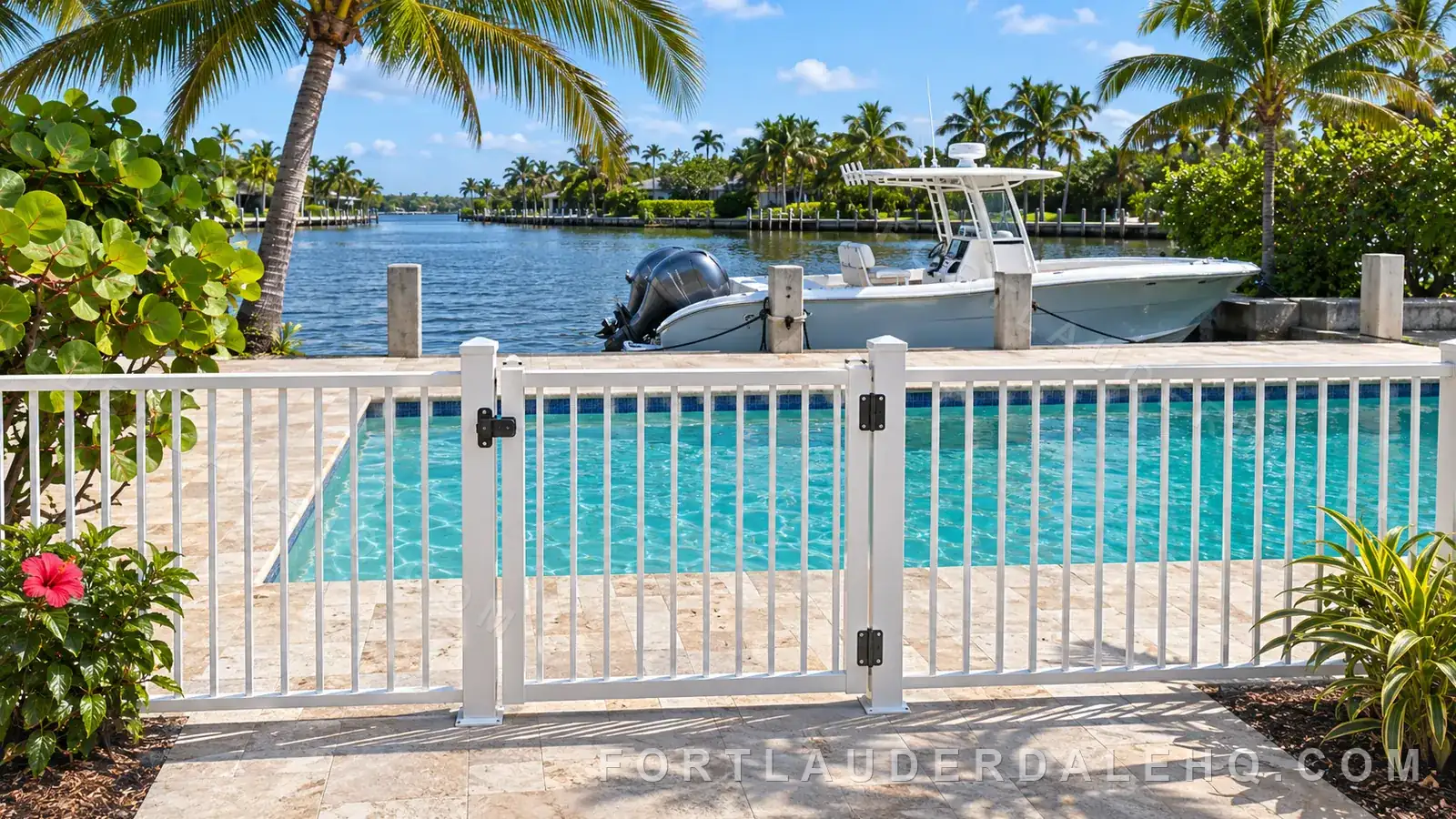
A pool, spa or hot tub needs a barrier that meets section 515.29 of the Florida Statutes and gates that open outward, close and latch by themselves, with the release on the pool side out of a young child's reach. On top of that, the house needs one more layer: an approved safety cover, net or baby fence; exit alarms of at least 85 dB at 10 feet on every door and window opening to the pool; self-closing, self-latching pool doors with the release at least 54 inches up; or an in-water pool alarm certified to ASTM F2208.
Outside, the swale must be clear, trip hazards gone and trash cans stored behind the property line. For a canal house, read the vehicle line twice: a trailer, RV or boat on the property must meet the City's land development rules. Fix any failed item and pass the reinspection within 30 calendar days, or the certificate is suspended until you do. No guest may stay before the certificate is issued.
When does a certificate expire, and what does renewal cost?
Every certificate expires on September 30. Renewal opens 180 days before that date and is due 60 days before it, which the City's renewal page sets at August 1. A renewal filed after the deadline but before September 30 pays a $100 late fee. After September 30, the file is treated as a new application at $880 with a new inspection. Renewal costs $650 for a property that is not owner-occupied and $200 for a homestead-exempt owner-occupied one, plus a separate $157.50 City business tax renewal.
Boating and buying questions
Does a vacation rental certificate transfer when I buy the house?
No, the ordinance says a registration cannot be transferred, assigned or used by anyone other than the person it was issued to, so a buyer files a new application, and a seller's open violations can follow the property where the City finds continuity of ownership or control.
Can I keep my boat trailer in the driveway of a vacation rental?
Only if it meets the City's land development rules, because the inspection checklist names trailers, RVs and boats on the property, and guest cars must park off the street in the spaces shown on your parking sketch.
How long does Fort Lauderdale take to issue a certificate?
The City says review takes about five business days after an application is accepted, an inspector reaches out within three business days once fees are paid, and the certificate follows within three business days of a passed inspection.
Does a lease longer than six months need any of this?
No, the City program covers stays shorter than 30 days or a calendar month, and both the state transient rental tax and the Broward tourist tax exempt a bona fide written lease longer than six months.
What should I ask a seller who rented the house by the week?
Ask for the certificate number, the last inspection result, the DBPR license, the tax account numbers and any open code case, then check the code status yourself in LauderBuild.
Where this leaves a buyer
We are not a brokerage, and nothing here is a view on what a rental would earn. Run the checklist against the house before you offer, and read the association rules too. The Property Taxes & Closing Costs page covers closing costs, Waterfront Homes lists canal homes, the beach towers are at Central Beach, and Sell Your Home explains how to reach a licensed agent by email.
Sources and review scope
Sources checked 2026-11-25. The notes identify which facts each publication supports.
- City of Fort Lauderdale: Ordinance No. C-26-39 (Legistar exhibit, CAM #26-0871)
The vacation rental definition, Ordinance C-15-29 of August 18, 2015, first reading August 18, 2026, effect 30 days after adoption, the $1,000 daily penalty, continuity of ownership or control, safety complaint access, the 24-hour responsible party, the non-transferable registration and the September 30 expiry.
- City of Fort Lauderdale: Vacation Rental Ordinance Amendment Adopted (notice)
Approval on September 15, 2026, the $250 to $1,000 increase for expired certificates, protection for timely renewals, the 180-day and 60-day renewal window, the $100 late fee, ownership changes and the active code violation rule.
- City of Fort Lauderdale: Vacation Rental Program
Ordinance C-26-39 as the governing amendment, its September 15, 2026 approval and the $1,000 daily penalty for operating without a valid certificate.
- City of Fort Lauderdale: Vacation Rental Registration
The order of state and county licenses, the notarized platform letter, LauderBuild, the parking sketch, the ten-day and five-day timelines, the $880, $100 and $50 fees, inspection scheduling and certificate timing, and two people per legal bedroom.
- City of Fort Lauderdale: Vacation Rental Inspection Checklist (2026)
Hard-wired smoke and CO alarms, the 2A:10B:C extinguisher, bedroom evacuation maps, land line, noise device with 180-day data, posted noise limits at 25 and 50 feet, pool barrier and the four extra pool options, trailers, RVs and boats, and the 30-day reinspection.
- City of Fort Lauderdale: Vacation Rental Renewal
The August 1 renewal deadline, September 30 expiry, the $100 late fee, new application at $880 after expiry, $650 and $200 renewal fees and the $157.50 business tax renewal.
- Florida DBPR: Vacation rental licensing guide
When a state vacation rental license is required, and the condominium and dwelling license classes.
- Florida Statutes s. 212.03, Transient rentals tax (2026)
The 6 percent state tax on transient rentals and the exemption for a bona fide written lease longer than six months.
- Broward County: Tourist Development Tax
The 6 percent county rate on rentals of six months or less, the written long-term lease exemption, assigned filing frequency, and returns due on the first and delinquent after the 20th.
Written by
Publisher and editor, Fort Lauderdale HQ
Fort Lauderdale HQ is an independent research publication. This article is not professional advice.